
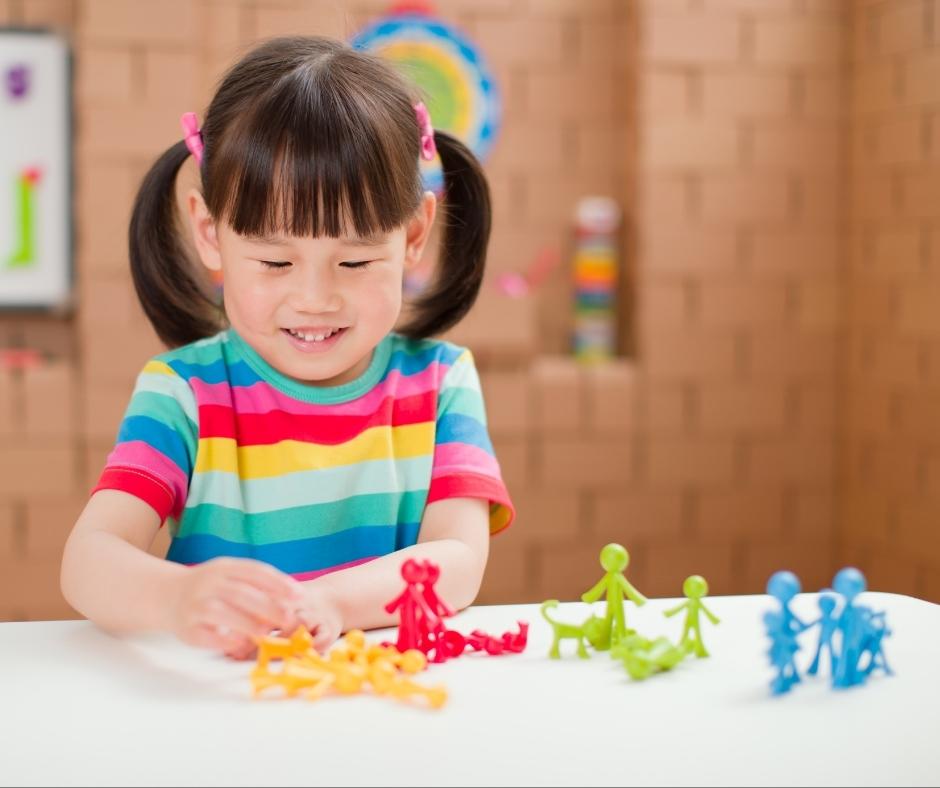
There are different ways to teach math to preschoolers and make it a fun experience. Not every preschooler learns the same way, and you will need to adjust to your young learner’s profile.
You are in the best position to encourage your child to discover, persist, and learn to become a problem solver.
Sometimes, your child will need extra support to master a concept, and every child reacts differently to new challenges, which is perfectly normal.
Therefore, one of the essential aspects of teaching math is creating a positive learning environment where young students feel comfortable, engaged, and motivated.
Four concepts can help you teach math outside the preschool classroom.
Teach Math in a Fun and Engaging Way
Young children learn best when they play. If you want to teach math to your child, remember that concept because it has been around for decades and promoted by the N.A.E.Y.C.
Hence, use their natural inclination to play and discover through play to teach age-appropriate math concepts.
Using games can help you naturally stimulate young learners to solve problems. One crucial point is to keep games short and multiply different games to help young learners acquire new skills.
One of the most important aspects is to keep games appropriately challenging as your child progresses and starts mastering new skills.
Remember that there is no fun when a game is too easy or complicated. Therefore, working through some level of challenge keeps games fun and engaging.
So, try to evaluate and adjust the game to the right level; that is simple enough to be engaging and challenging enough to be fun.
Games will help ease young children into math concepts without creating stress, fear, or sadness. Again, a play-based approach and a positive learning environment can help your young learners progress.
Make Kids Think Differently
It’s emotionally hard to see young children struggle, especially when you are the parent of a child starting with math.
Therefore, it is not uncommon to witness parents’ natural inclination to promptly give answers to their children when they perceive that they are stuck and cannot immediately find the solution to a math question.
Unfortunately, this will not help your child solve a problem when all they need is simply some more time and another chance to rethink before finding the correct answer.
Therefore, we always encourage parents to refrain from answering immediately.
Consider that if you answer, you eliminate the challenge for your child. Without an age-appropriate challenge, there is no learning possible.
Instead, try to ask open-ended questions.
Help your child rethink the problem and avoid the frustration of being blocked and not knowing the answer. Sometimes, asking different questions helps trigger new reflections and responses.
If, after two or three questions, your child has not found the answer, then give them some hints or guidance:
- How about we try this…
- What would happen if…
- Let’s do this…
- What if you…
Helping them to think differently is a foundation of problem-solving.
There is nothing wrong with trial and error when practicing math. Remember your high school years; it takes practice, repetition, and patience to understand math and get it right. The same principles apply to your young learner. The most important thing is to keep the activity fun and engaging and avoid frustration.
Repetition is Essential
Repeating will help your child become more fluent and comfortable with math concepts and improve self-confidence and independence.
Playing the same game may sound boring and unfun for adults.
But young children love to manipulate objects and concepts over and over. It helps them progressively acquire new skills to reach new milestones in their cognitive development.
Rest assured that if your child gets bored and does not want to play the same game, they will move on naturally to something else.
Ultimately, if they have learned what they had to, they will be ready to learn something new, and if they have reached their limit, they will do something else.
Give A Meaningful Feedback
If your child demonstrates progress or mastery of a math concept, give them positive feedback.
It does not mean to praise with a vain and superficial “good job, you did it” but rather appreciate the effort or attitude.
- I am proud of you because you did not give up…
- I like that the way you stayed calm…
- I love how hard you worked…
In other words, explain what you like about your child working on a math problem instead of the result. We do not suggest offering an empty positive reinforcement for the sake of it.
Your feedback is an opportunity to acknowledge an effort and establish that struggling is okay and natural, but the right attitude can make a difference.
When math becomes more complex during your child’s school years, being equipped with the right mindset will help them during challenging times.
Your Takeaways
If you want to teach math outside the preschool classroom, you have a unique opportunity to help your child progress and acquire new skills.
Remember that math is essential in developing logical thinking, reasoning, and problem-solving skills. Therefore, keep it fun to make it exciting and attractive and avoid unnecessary frustrations and anxiety, especially with young children.
Keep in mind our strategies:
- Use short games and multiply games and keep it fun.
- If they are stuck, do not answer. Use open-ended questions to help them think differently, and use hints and guidance if questions do not work.
- Let them repeat over and over again. The repetitive practice of math concepts will help acquire and mature skills.
- Offer meaningful feedback to your child and highlight what you like about their attitude when they manipulate math concepts.
If you are unsure how to teach math and need to prepare your child for kindergarten, please reach out to our team.